
‘PATAPHYSICS AND THE LINE
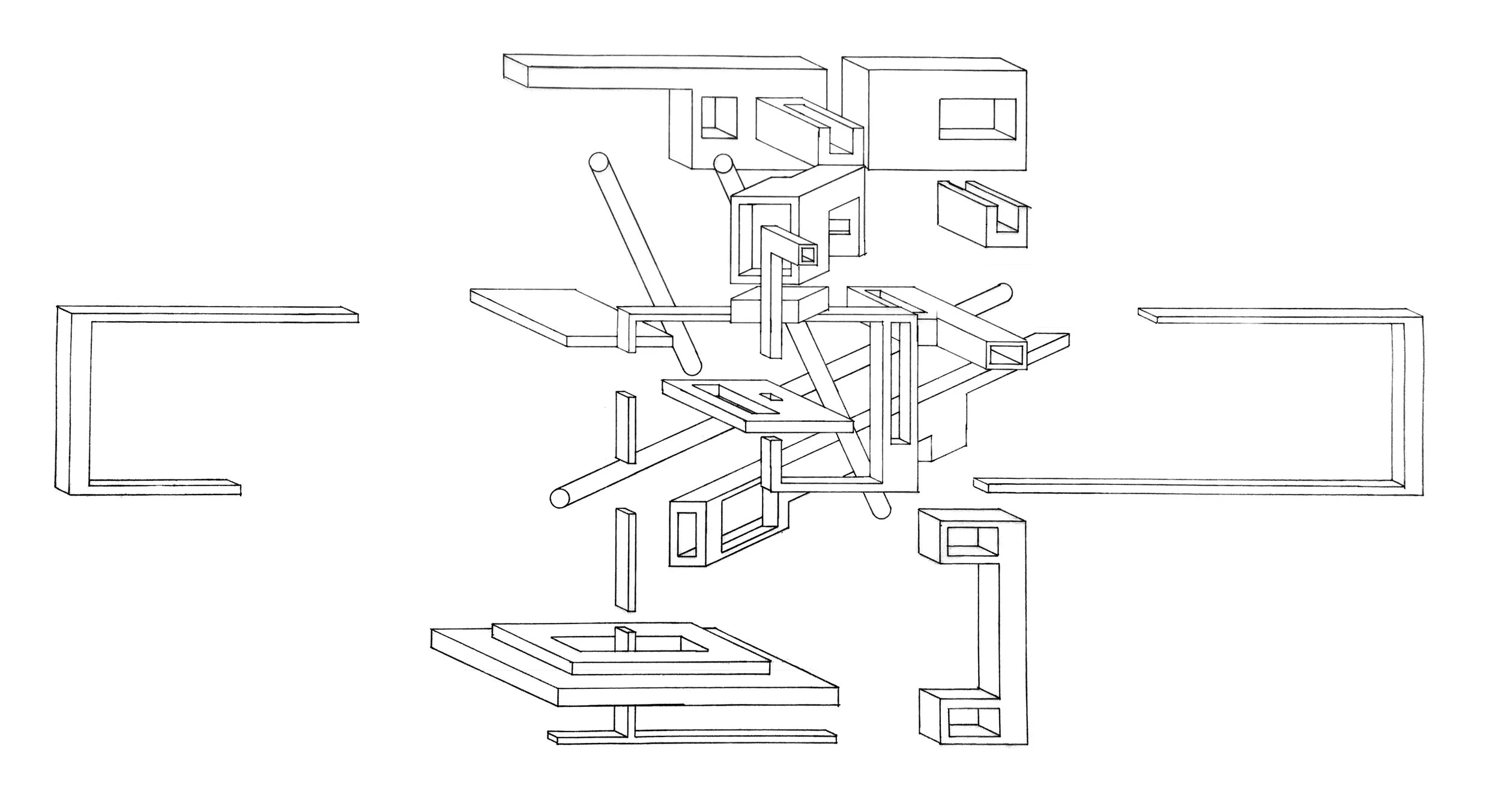
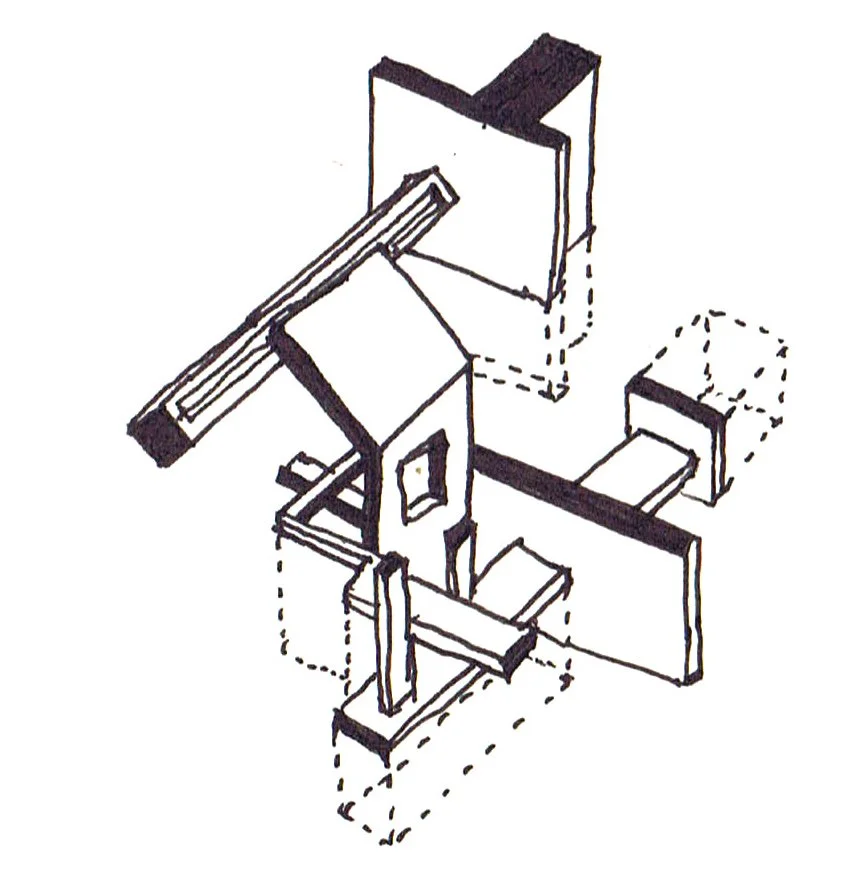
A line is made, but what is that line? Is it a whole? Is it a axis? Is it an edge condition? Is it a path? Is it a trajectory? Is it an emotion? Is it figurative? Is it an abstract gesture? Is it all of these? Whatever the line may ‘be’, in ‘Pataphysical drawing practice, translation does not originate from something pre-conceived or definitive, but instead from an unfolding labyrinth of projective and speculative thoughts. Through this, the maker is placed into a state of cognitive discovery, catalysing projections of proportion, scale, meaning, and composition that were not previously present before. What is defined by a line is an open question. No matter how strict and defined a axonometric line many at first seem, through ‘Patapyscial practice a mechanism of embodied call and response is triggered, with each line revealing a possibility rather than a definitive content.
The drawings do ignore or reject the ocular precision and accuracy of axonometry and isometry, but instead disregard, misinterpret, and re-configure the logical functions of these projective methods of quantifiably . Consequently, all drawn digressions are not a deviation towards something understood, but instead are a digression toward something shrouded by the perceptive limitations of human consciousness. From this non-definitive and unguided state of reflexion, an outlier to a rational system emerges, revealing the emancipating anomaly. In this art practice, reflexion is enacted through drawing, which necessitates an intuitive and impulsive process of creation.
Dr David Boyd is an artist and practitioner at the School of Architecture, Planning & Landscape at Newcastle University, where he has co-run a Master’s design studio since 2019. Through critical inquiry by creative practice, his research and teaching investigates hand drawing as an essential instrument for spatial invention, and examines the political, ethical, and practical tensions between traditional architectural making and the contemporary modes of technocratic production. His doctoral thesis, titled ‘Fallible Projections: The Resistant Mechanisms of a Pataphysical Practice’, examines the technical ocular language of isometric and axonometric projection through the lens of Alfred Jarry’s philosophy of Pataphysics: a late 19th-century movement that embraces the invention of ‘imaginary solutions’. Through the creation of 38 hand-drawn plates, the research critically reconfigures the technical design language of axonometry and isometry into a space for embodied poetic invention, speculating ways of spatial invention that resist the commercially facilitative, architecturally restrictive mechanisms of contemporary production. He has recently co-edited a book titled ‘Embodied Awareness of Space: Body, Agency, and Current Practice,’ which was published by Palgrave Macmillan in January 2025.