
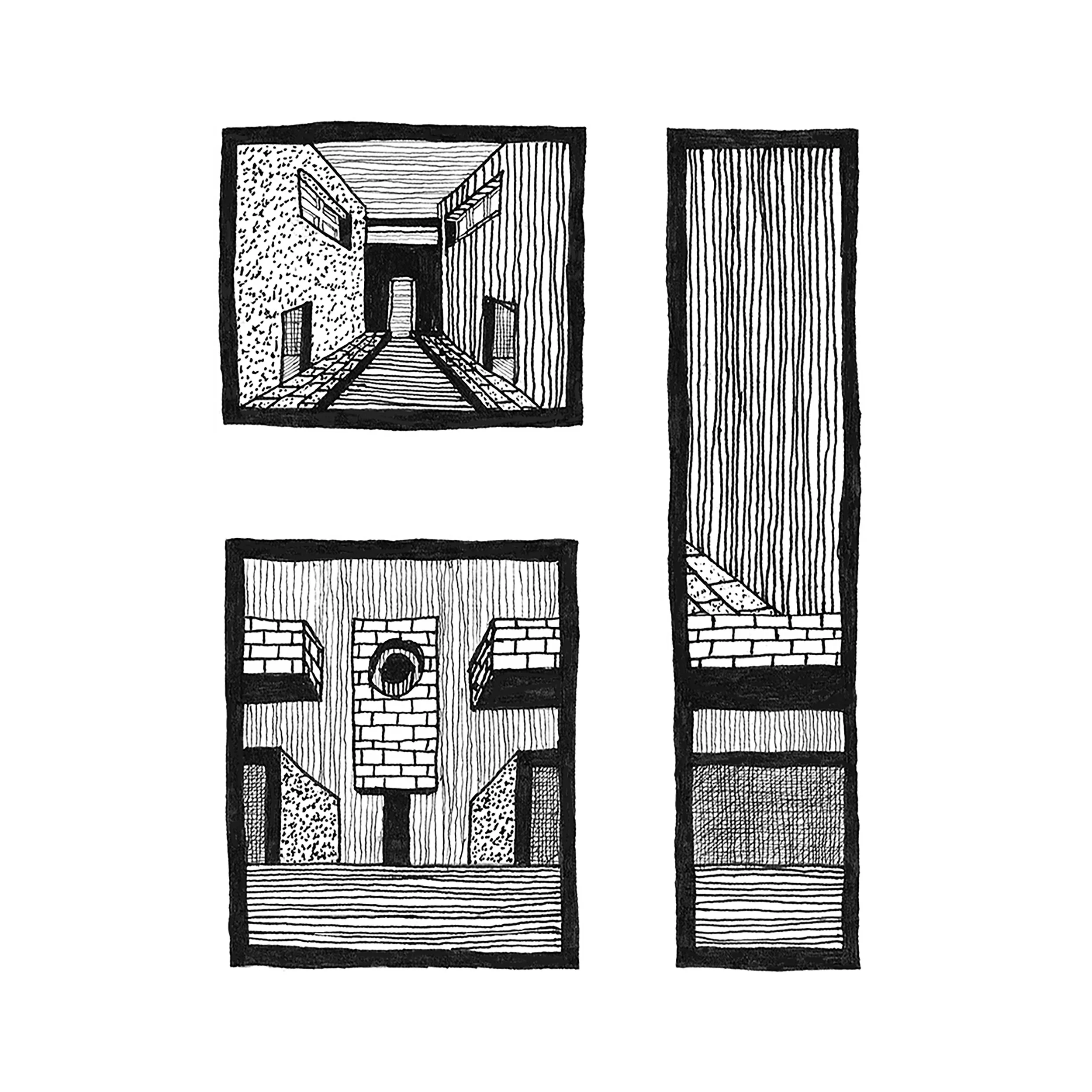
QUIRINAL PALACE
The Quirinal Palace in Rome invites rupture due to its focus and celebration of the constructed separation between different social classes. It is a spatial diagram of imbalance and social disregard. In this spatial dynamic, the resistant architectural gesture is to rupture with inhabitation. Not with a claim of ‘sensitivity’, but to confront and re-configure the suppressive conditions of hierarchical space. Consequently, in response to the closed gesture of the Quirinale Palace, Plan constructs a city block that infiltrates, deconstructs, and reconfigures the walls of the palace grounds. The suggestion and consideration of use, or at least inhabitation, is a primary force that drives the exploration. A material or formal language is not a primary concern, but instead, the projections take the first translatory steps towards an embodied experience.
The drawing interrogates how previous studies in the research translate into more delineated or tangible architectural projections. To construct the morphology of Plan, plates from the Autonomous series were collaged and overlaid. A crucial compositional shift that happened in this process was that only the solid black in the Autonomous drawings was extracted, and the lines that sat within the frames were removed. Through the collaging/stitching process compositional/spatial configuration emerged. In dialogue with LOCUS, the resulting composition acts as a morphology form which to discover and extract space. Through this action, an inhabitable city block emerges through the dialogue between solid and void, suggesting a more grounded architectural configuration.
Plan, (2022) Ink, 180gsm Paper
Failed projection 1, (2022) Ink, 180gsm Paper
Failed projection 2, (2022) Ink, 180gsm paper
Failed section, (2022) Ink, 180gsm paper
Necessary Realignment, (2022) Ink, 180gsm paper