
 Image 1 of 1
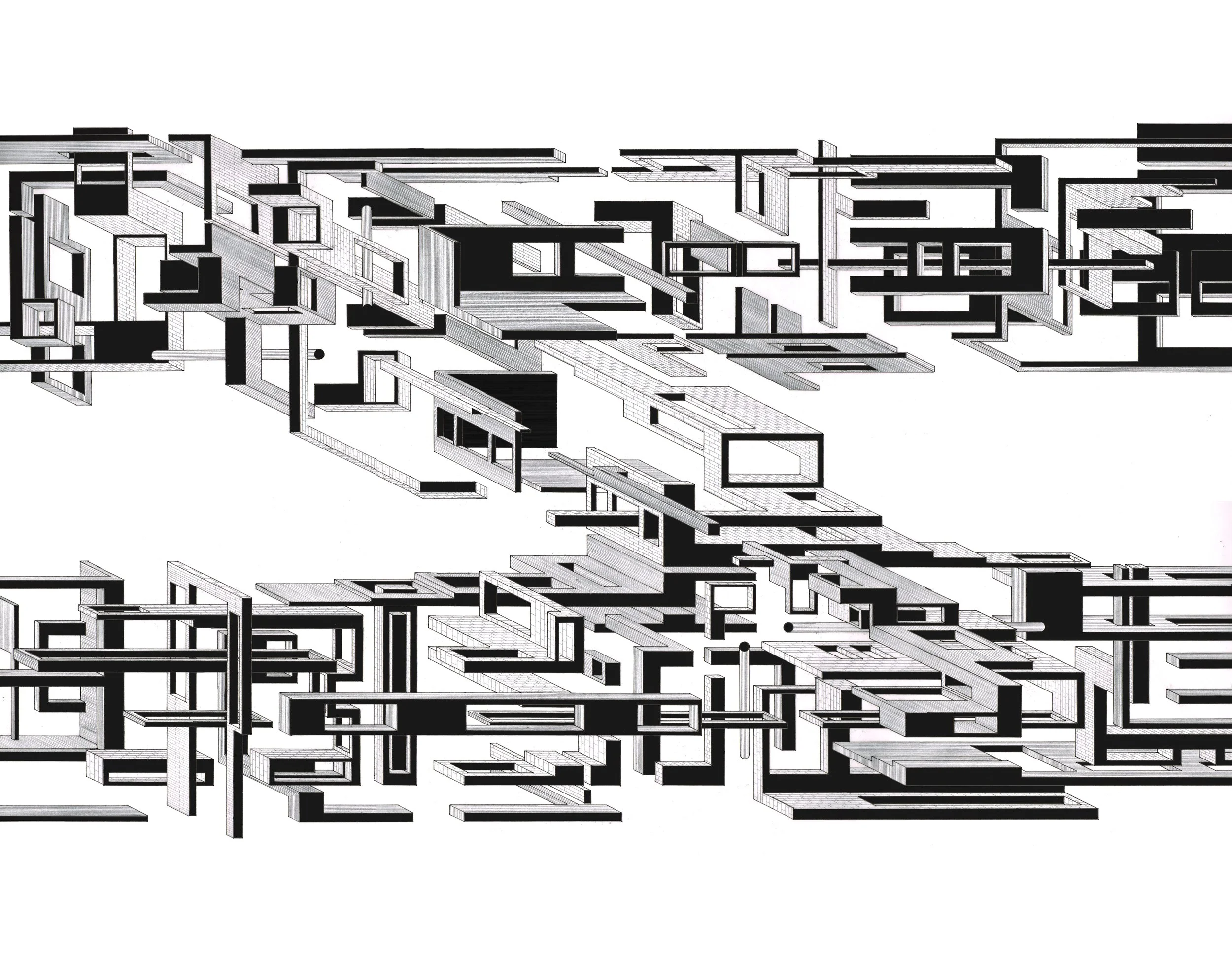
This gyclee print of my artwork, Two Horizons, is produced using archival ink and is printed on high quality 290gsm art paper. All of my drawings are hand drawn using traditional architectural draughting methods.
This print is available in:
210mm x 297mm (A4)
297mm x 420mm (A3)
420mm x 594mm (A2)
Custom sizes available, just get in contact
(Original dimensions of the work are 420mm x 594mm. (16.5” x 23.4”)
All orders will be shipped in protective mailing tubes. Please allow 3 - 5 working days for your order to be processed.
Two Horizons - (2020) Ink, Graphite, Paper
Two Horizons returns to oblique projection, excavating its capacity to produce instability and moments of visual rupture. Rather than avoiding these effects, the drawing actively engages them, allowing contradiction to become a central mechanism.
The drawing is structured through a split field. In the upper section, lines extend in one direction; in the lower, they follow the same angle but project in reverse. This reversal creates a sustained conflict, where the drawing cannot resolve into a stable spatial reading.
As a result, the work is in a state continuous translation, shifting between multiple possibilities without ever stabilising into a singular conclusion. What emerges is not clarity, but an instability in which perception is held in perpetual tension.
This gyclee print of my artwork, Two Horizons, is produced using archival ink and is printed on high quality 290gsm art paper. All of my drawings are hand drawn using traditional architectural draughting methods.
This print is available in:
210mm x 297mm (A4)
297mm x 420mm (A3)
420mm x 594mm (A2)
Custom sizes available, just get in contact
(Original dimensions of the work are 420mm x 594mm. (16.5” x 23.4”)
All orders will be shipped in protective mailing tubes. Please allow 3 - 5 working days for your order to be processed.
Two Horizons - (2020) Ink, Graphite, Paper
Two Horizons returns to oblique projection, excavating its capacity to produce instability and moments of visual rupture. Rather than avoiding these effects, the drawing actively engages them, allowing contradiction to become a central mechanism.
The drawing is structured through a split field. In the upper section, lines extend in one direction; in the lower, they follow the same angle but project in reverse. This reversal creates a sustained conflict, where the drawing cannot resolve into a stable spatial reading.
As a result, the work is in a state continuous translation, shifting between multiple possibilities without ever stabilising into a singular conclusion. What emerges is not clarity, but an instability in which perception is held in perpetual tension.