
 Image 1 of 1
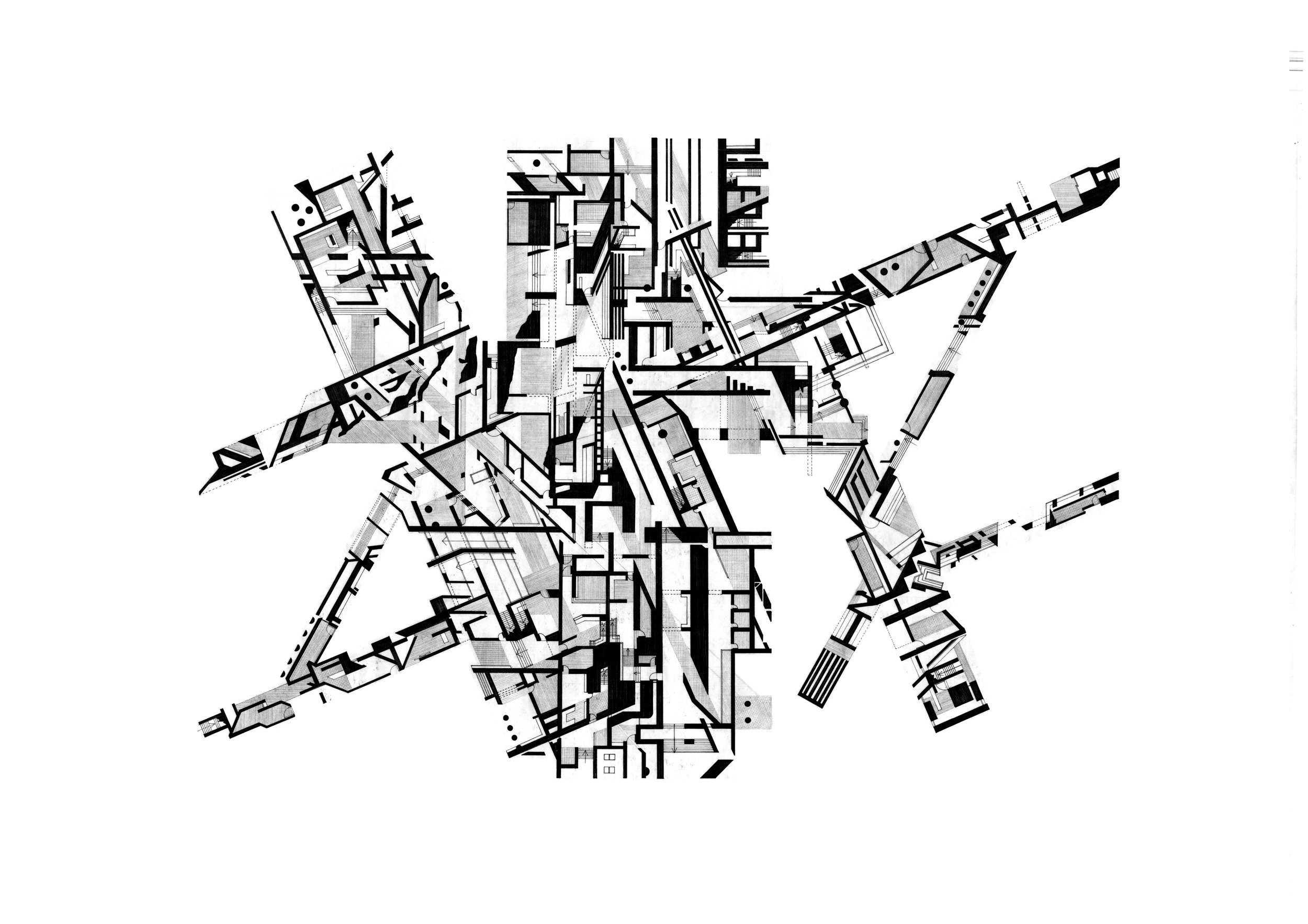
This gyclee print of my artwork, Plan, is produced using archival ink and is printed on high quality 290gsm art paper. All of my drawings are hand drawn using traditional architectural draughting methods.
This print is available in:
210mm x 297mm (A4)
297mm x 420mm (A3)
420mm x 594mm (A2)
Custom sizes available, just get in contact
(Original dimensions of the work are 594mm x 841mm.
All orders will be shipped in protective mailing tubes. Please allow 3 - 5 working days for your order to be processed.
Plan - (2022) Ink, Paper
Plan responds to the socially enclosed condition of the Quirinal Palace in Rome by constructing a new spatial arrangement that infiltrates and reworks its boundaries. The drawing suggests the possibility of use and inhabitation, not as a fixed proposal, but as an emerging condition.
The work developed through a process of collage, using fragments taken from TheAutonomous series. By isolating areas of solid black and removing internal line-work of those drawings a new structure forms. This layered composition establishes a field of solids and voids from which spatial configurations emerge and are discovered.
Through this process, the drawing moves toward a more grounded sense of organisation, where form begins to suggest embodied occupation. The result is not a plan in the conventional sense, but a generative framework—an open structure that supports further invention.
This gyclee print of my artwork, Plan, is produced using archival ink and is printed on high quality 290gsm art paper. All of my drawings are hand drawn using traditional architectural draughting methods.
This print is available in:
210mm x 297mm (A4)
297mm x 420mm (A3)
420mm x 594mm (A2)
Custom sizes available, just get in contact
(Original dimensions of the work are 594mm x 841mm.
All orders will be shipped in protective mailing tubes. Please allow 3 - 5 working days for your order to be processed.
Plan - (2022) Ink, Paper
Plan responds to the socially enclosed condition of the Quirinal Palace in Rome by constructing a new spatial arrangement that infiltrates and reworks its boundaries. The drawing suggests the possibility of use and inhabitation, not as a fixed proposal, but as an emerging condition.
The work developed through a process of collage, using fragments taken from TheAutonomous series. By isolating areas of solid black and removing internal line-work of those drawings a new structure forms. This layered composition establishes a field of solids and voids from which spatial configurations emerge and are discovered.
Through this process, the drawing moves toward a more grounded sense of organisation, where form begins to suggest embodied occupation. The result is not a plan in the conventional sense, but a generative framework—an open structure that supports further invention.