
 Image 1 of 1
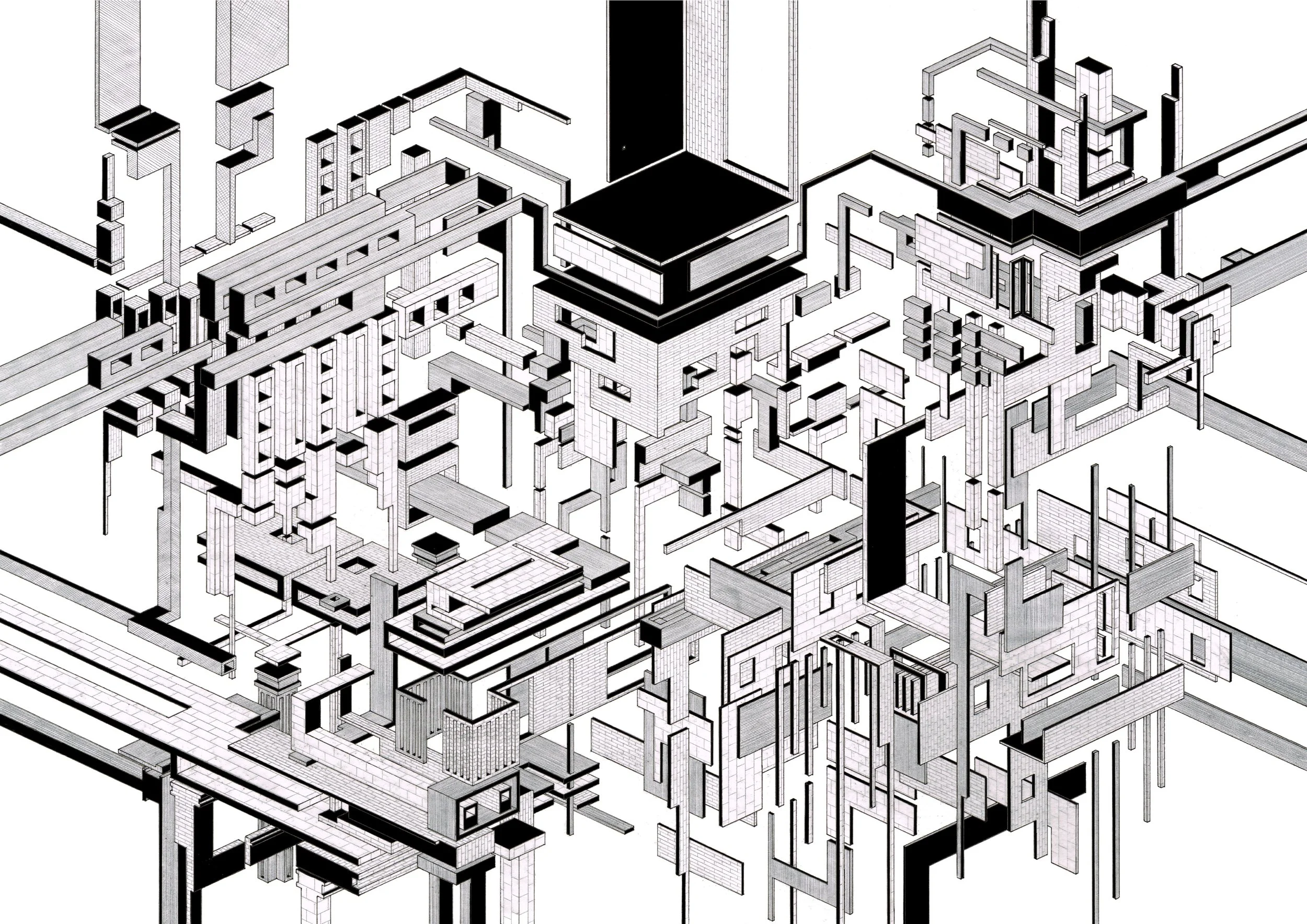
This gyclee print of my artwork, Italy, is produced using archival ink and is printed on high quality 290gsm art paper. All of my drawings are hand drawn using traditional architectural draughting methods.
This print is available in:
210mm x 297mm (A4)
297mm x 420mm (A3)
420mm x 594mm (A2)
Custom sizes available, just get in contact
(Original dimensions of the work are 420mm x 594mm. (16.5” x 23.4”)
All orders will be shipped in protective mailing tubes. Please allow 3 - 5 working days for your order to be processed.
Italy - (2020)Ink, Graphite, Paper
Italy explores the act of mapping as a speculative process rather than a descriptive one. Instead of recording an existing journey, the drawing constructs a trip that has not yet occurred, shaped by anticipation, assumption, and bias.
The lines follow an imagined route - Milan, Como, Verona, Venice, and Rome - with each location translated into their own fragments on the page. These fragments do not aim for accuracy, but instead to form a fluctuating network of impressions, where differences in structure and form reflect variations in expectation rather than experience.
This gyclee print of my artwork, Italy, is produced using archival ink and is printed on high quality 290gsm art paper. All of my drawings are hand drawn using traditional architectural draughting methods.
This print is available in:
210mm x 297mm (A4)
297mm x 420mm (A3)
420mm x 594mm (A2)
Custom sizes available, just get in contact
(Original dimensions of the work are 420mm x 594mm. (16.5” x 23.4”)
All orders will be shipped in protective mailing tubes. Please allow 3 - 5 working days for your order to be processed.
Italy - (2020)Ink, Graphite, Paper
Italy explores the act of mapping as a speculative process rather than a descriptive one. Instead of recording an existing journey, the drawing constructs a trip that has not yet occurred, shaped by anticipation, assumption, and bias.
The lines follow an imagined route - Milan, Como, Verona, Venice, and Rome - with each location translated into their own fragments on the page. These fragments do not aim for accuracy, but instead to form a fluctuating network of impressions, where differences in structure and form reflect variations in expectation rather than experience.