
 Image 1 of 1
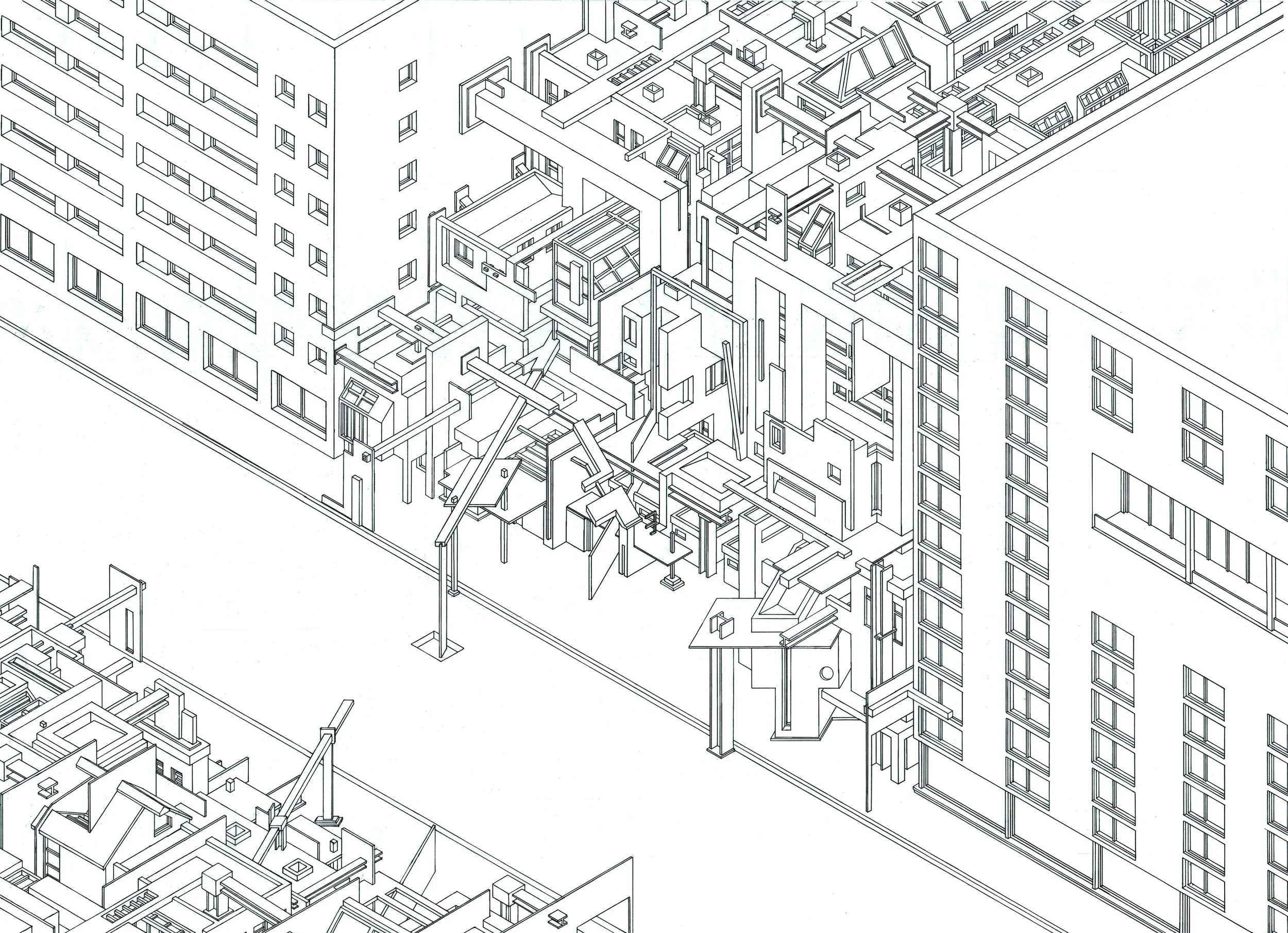
This gyclee print of my artwork, Infill, is produced using archival ink and is printed on high quality 290gsm art paper. All of my drawings are hand drawn using traditional architectural draughting methods.
This print is available in:
210mm x 297mm (A4)
297mm x 420mm (A3)
420mm x 594mm (A2)
Custom sizes available, just get in contact
(Original dimensions of the work are 594mm x 841mm.
All orders will be shipped in protective mailing tubes. Please allow 3 - 5 working days for your order to be processed.
Infill - (2024) Ink, Paper
Infill develops from the material-driven explorations navigated in TheQuirinale Palace series, extending its focus on embodiment and tectonic assembly.
The drawing explores the notion of the in-between, responding to the constraint of context. From this, lines emerge through a responsive action in which each line contributes to a larger constructed assemblage, always avoiding purely compositional gestures.
Rather than beginning with a final form, the work develops through accumulation. Chambers and volumes are shaped by memory, perception, and the embodied act of drawing. As the drawing unfolds, fragments open and reconnect, producing a shifting field where structure is both exposed and reconfigured.
This gyclee print of my artwork, Infill, is produced using archival ink and is printed on high quality 290gsm art paper. All of my drawings are hand drawn using traditional architectural draughting methods.
This print is available in:
210mm x 297mm (A4)
297mm x 420mm (A3)
420mm x 594mm (A2)
Custom sizes available, just get in contact
(Original dimensions of the work are 594mm x 841mm.
All orders will be shipped in protective mailing tubes. Please allow 3 - 5 working days for your order to be processed.
Infill - (2024) Ink, Paper
Infill develops from the material-driven explorations navigated in TheQuirinale Palace series, extending its focus on embodiment and tectonic assembly.
The drawing explores the notion of the in-between, responding to the constraint of context. From this, lines emerge through a responsive action in which each line contributes to a larger constructed assemblage, always avoiding purely compositional gestures.
Rather than beginning with a final form, the work develops through accumulation. Chambers and volumes are shaped by memory, perception, and the embodied act of drawing. As the drawing unfolds, fragments open and reconnect, producing a shifting field where structure is both exposed and reconfigured.