
 Image 1 of 2
 Image 2 of 2
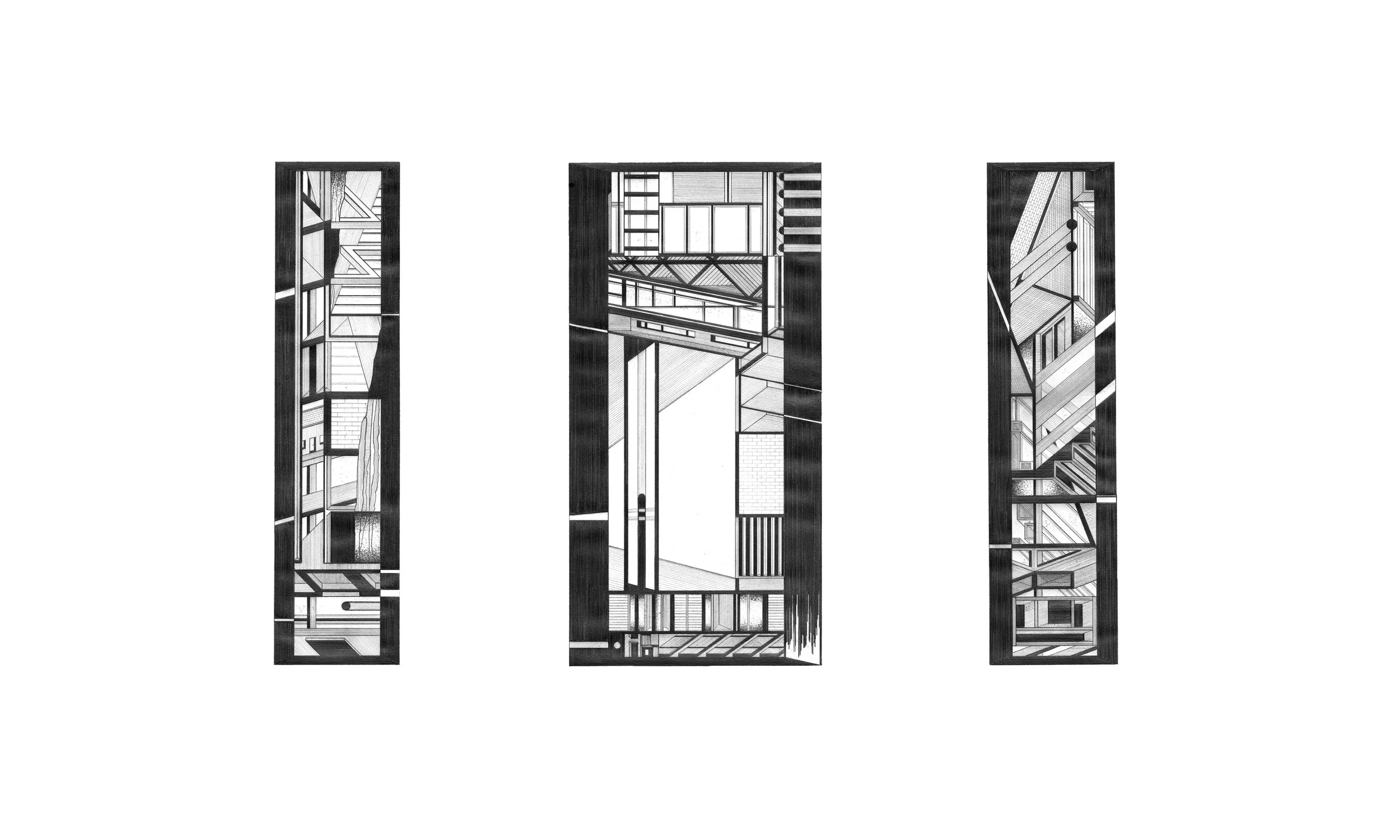
This gyclee print of my artwork, Fancy a Tab?, is produced using archival ink and is printed on high quality 290gsm art paper. All of my drawings are hand drawn using traditional architectural draughting methods.
This print is available in:
210mm x 297mm (A4)
297mm x 420mm (A3)
420mm x 594mm (A2)
Custom sizes available, just get in contact
(Original dimensions of the work are 420mm x 594mm. (16.5” x 23.4”)
All orders will be shipped in protective mailing tubes. Please allow 3 - 5 working days for your order to be processed.
Fancy a Tab Triptych (Trip, Airport, Langhorn) - (2019) Graphite, Paper
Airport (centre) draws on the technical spatial language of highly controlled, repetitive environments shaped by efficiency and enclosure (such as airports). Rather than studying a specific site, the drawing reconstructs this condition through fragments of memory, translating it into a speculative field.
Beginning from a defined frame rather than a blank page, the work establishes an enclosed visual space in which invention can occur. This reflects an ongoing tension within the practice: whether constraint limits creativity, or enables it.
Trip (left) maps a series of spatial moments shaped by regret. Freehand lines and marks register an attempt to confront and rework experiences that resist resolution.
Rather than erasing these traces, the drawing allows them to persist and reappear, suggesting that unwanted conditions remain active within the process. Through this, a form of desire begins to surface—uncertain, but present.
Langhorn (right) documents a house in Byker, Newcastle upon Tyne, assembling a fragmented record of contextual conditions. Like the other plates of the triptych Langhorn remains closely tied to an existing place, limiting the scope for transformation.
This constraint reveals a tension between description and invention. While the composition may resolve visually, the drawing exposes the difficulty of moving beyond a direct representation—highlighting the need for a process of abstract translation rather than simple reproduction.
This gyclee print of my artwork, Fancy a Tab?, is produced using archival ink and is printed on high quality 290gsm art paper. All of my drawings are hand drawn using traditional architectural draughting methods.
This print is available in:
210mm x 297mm (A4)
297mm x 420mm (A3)
420mm x 594mm (A2)
Custom sizes available, just get in contact
(Original dimensions of the work are 420mm x 594mm. (16.5” x 23.4”)
All orders will be shipped in protective mailing tubes. Please allow 3 - 5 working days for your order to be processed.
Fancy a Tab Triptych (Trip, Airport, Langhorn) - (2019) Graphite, Paper
Airport (centre) draws on the technical spatial language of highly controlled, repetitive environments shaped by efficiency and enclosure (such as airports). Rather than studying a specific site, the drawing reconstructs this condition through fragments of memory, translating it into a speculative field.
Beginning from a defined frame rather than a blank page, the work establishes an enclosed visual space in which invention can occur. This reflects an ongoing tension within the practice: whether constraint limits creativity, or enables it.
Trip (left) maps a series of spatial moments shaped by regret. Freehand lines and marks register an attempt to confront and rework experiences that resist resolution.
Rather than erasing these traces, the drawing allows them to persist and reappear, suggesting that unwanted conditions remain active within the process. Through this, a form of desire begins to surface—uncertain, but present.
Langhorn (right) documents a house in Byker, Newcastle upon Tyne, assembling a fragmented record of contextual conditions. Like the other plates of the triptych Langhorn remains closely tied to an existing place, limiting the scope for transformation.
This constraint reveals a tension between description and invention. While the composition may resolve visually, the drawing exposes the difficulty of moving beyond a direct representation—highlighting the need for a process of abstract translation rather than simple reproduction.