
 Image 1 of 1
This gyclee print of my artwork, Door Bar, is produced using archival ink and is printed on high quality 290gsm art paper. All of my drawings are hand drawn using traditional architectural draughting methods.
This print is available in:
210mm x 297mm (A4)
297mm x 420mm (A3)
420mm x 594mm (A2)
Custom sizes available, just get in contact
(Original dimensions of the work are 420mm x 594mm. (16.5” x 23.4”)
All orders will be shipped in protective mailing tubes. Please allow 3 - 5 working days for your order to be processed.
Door Bar - (2019) Graphite, Paper
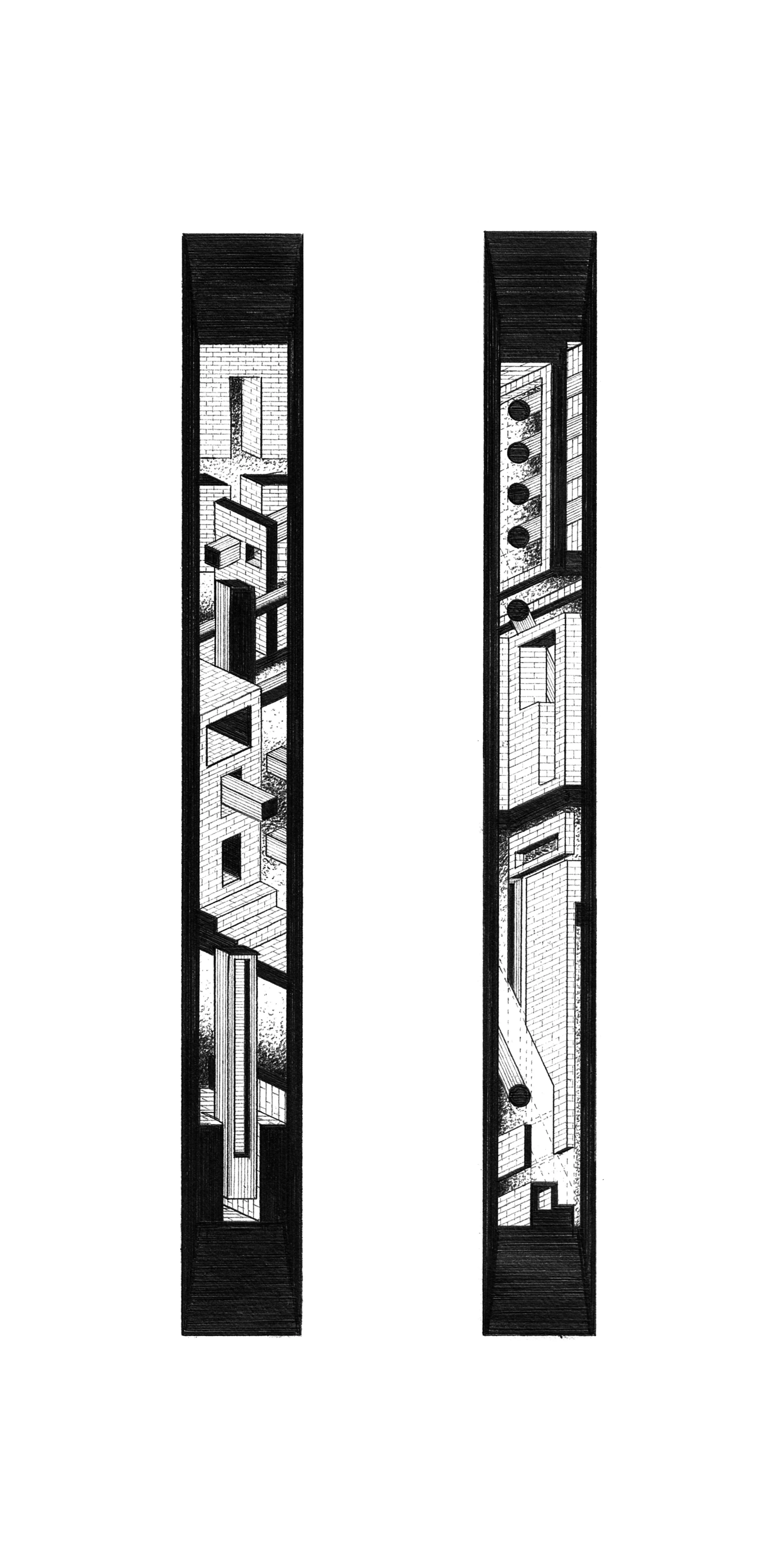
Door Bar focuses on enclosure and separation, exploring how these conditions are constructed and experienced within the frame.
The drawing is divided into two sections. On the left, enclosure is approached through a physical mechanism, translating movement and interaction. On the right, the work extends the compositional language developed in Form Like Christ, further testing its capacity to generate new spatial conditions.
Across both sections, iterative repetition begins to surface. What once operated as a generative framed structure now reveals its limits, exposing the frame as both a tool and an overbearing constraint.
As such, Door Bar marks a point of hesitation —where the reliance on framing structures begins to break down, and the possibility of moving beyond them starts to emerge.
This gyclee print of my artwork, Door Bar, is produced using archival ink and is printed on high quality 290gsm art paper. All of my drawings are hand drawn using traditional architectural draughting methods.
This print is available in:
210mm x 297mm (A4)
297mm x 420mm (A3)
420mm x 594mm (A2)
Custom sizes available, just get in contact
(Original dimensions of the work are 420mm x 594mm. (16.5” x 23.4”)
All orders will be shipped in protective mailing tubes. Please allow 3 - 5 working days for your order to be processed.
Door Bar - (2019) Graphite, Paper
Door Bar focuses on enclosure and separation, exploring how these conditions are constructed and experienced within the frame.
The drawing is divided into two sections. On the left, enclosure is approached through a physical mechanism, translating movement and interaction. On the right, the work extends the compositional language developed in Form Like Christ, further testing its capacity to generate new spatial conditions.
Across both sections, iterative repetition begins to surface. What once operated as a generative framed structure now reveals its limits, exposing the frame as both a tool and an overbearing constraint.
As such, Door Bar marks a point of hesitation —where the reliance on framing structures begins to break down, and the possibility of moving beyond them starts to emerge.